Timestamp Alignments That Refine Precision in Recurring Deductions Across Distributed Service Platforms
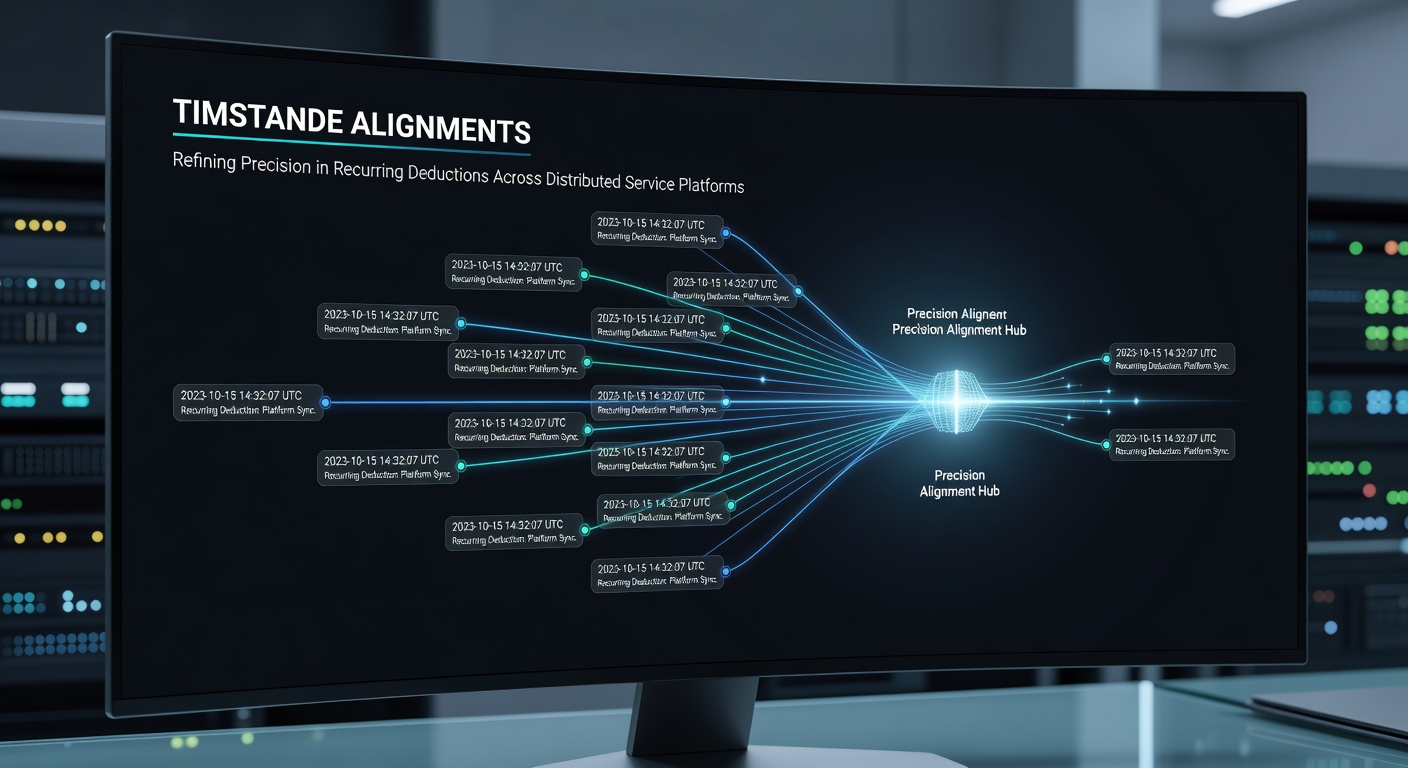
Distributed service platforms rely on coordinated timestamp alignments to maintain accuracy when processing recurring deductions, and this coordination becomes essential as networks span multiple geographic regions with varying latency profiles. Service providers use protocols such as Network Time Protocol and Precision Time Protocol to synchronize clocks across nodes, which reduces discrepancies that otherwise lead to duplicate charges or missed billing cycles in subscription models. Observers note that even millisecond-level offsets can accumulate over thousands of transactions, prompting platform architects to implement continuous alignment mechanisms rather than relying on periodic checks alone.
Core Mechanisms Behind Timestamp Coordination
Clock skew arises naturally in distributed environments because individual servers maintain independent oscillators that drift at different rates, and researchers have documented how this drift directly impacts the sequencing of recurring payment events. Alignment techniques address the issue by exchanging timing packets between nodes and adjusting local clocks accordingly, which creates a shared temporal reference frame that all deduction processes can reference. Studies from institutions tracking payment infrastructure show that platforms adopting hierarchical synchronization models achieve tighter bounds on event ordering compared with flat peer-to-peer approaches, especially when traffic volumes spike during monthly billing windows.
Impact on Deduction Accuracy
When timestamps align within sub-millisecond tolerances, recurring deduction engines can distinguish between legitimate renewal attempts and retry operations triggered by transient network failures, thereby preventing erroneous double-billing scenarios that erode user trust. Data compiled by payment processing consortia indicates that misalignment errors account for a measurable fraction of customer disputes in multi-region subscription services, and resolution of those disputes consumes significant operational resources. Alignment refinements therefore translate into measurable reductions in reconciliation workloads for finance teams who must otherwise manually review flagged transactions each cycle.
Platforms that operate across cloud regions often deploy boundary clocks and transparent clocks to propagate timing signals with minimal jitter, and these hardware-assisted methods complement software-based corrections. In June 2026 several major cloud providers began rolling out enhanced PTP profiles that incorporate machine-learning predictions of network congestion, allowing preemptive adjustments before drift exceeds acceptable thresholds. Those updates build on earlier standards and demonstrate how ongoing refinements continue to tighten the precision window available for deduction logic.
Implementation Patterns Across Service Architectures
Engineers integrate timestamp alignment at multiple layers, from the operating-system kernel up through application-level schedulers that trigger recurring charges. One common pattern involves embedding sequence numbers alongside synchronized timestamps so that downstream processors can reconstruct event order even if minor packet reordering occurs during transit. Reports from academic groups studying large-scale distributed ledgers confirm that this dual-layer approach maintains consistency across millions of daily deductions while keeping computational overhead within acceptable limits for high-throughput environments.
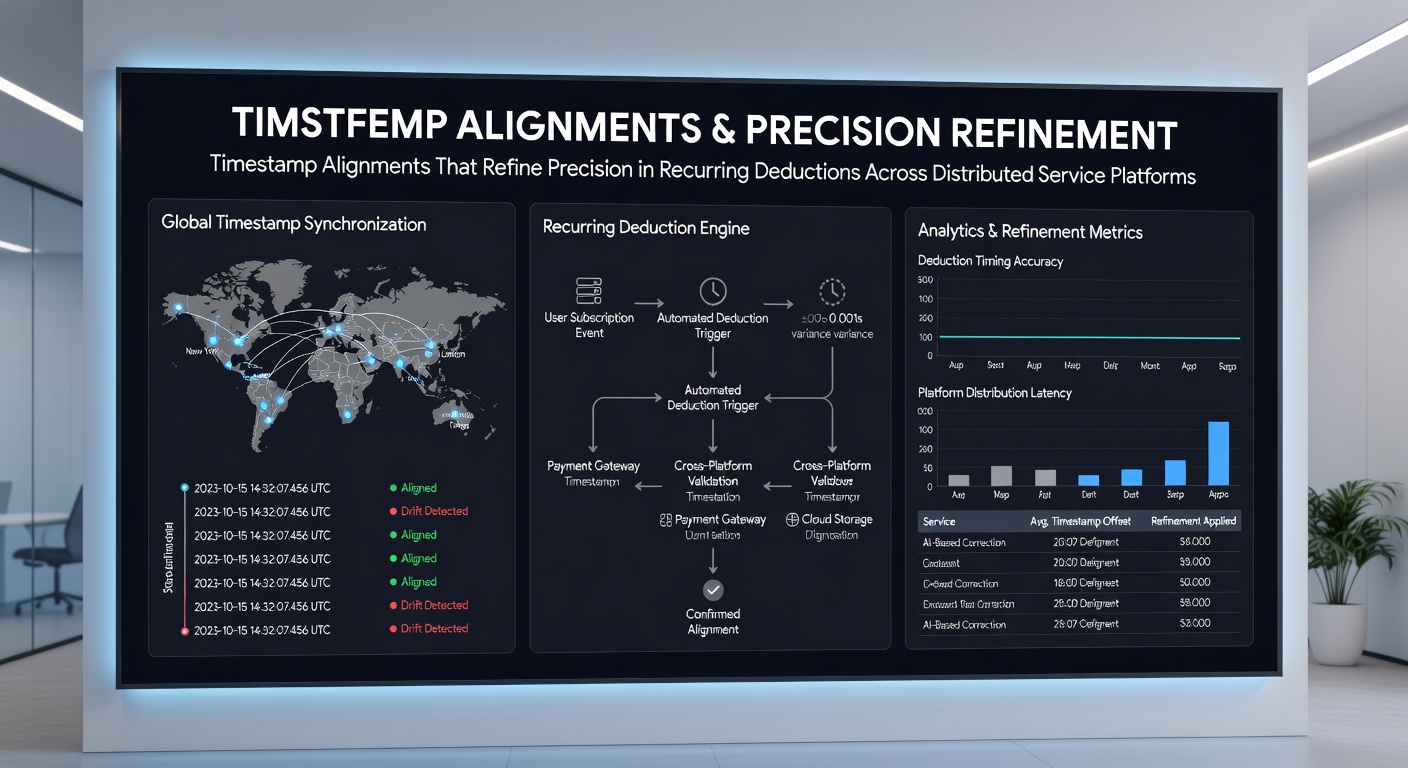
Service operators also maintain audit logs that record both the aligned timestamp and the raw local clock reading at the moment of deduction, which creates a traceable history for compliance reviews. Regulatory bodies in multiple jurisdictions, including the Monetary Authority of Singapore, have referenced such logging practices in guidance documents that address transparency in automated financial processes. The combination of precise timing and immutable records allows external auditors to verify that deductions occurred within contracted billing windows without relying on post-hoc estimations.
Emerging Standards and Measurement Practices
Industry groups continue to refine measurement methodologies that quantify alignment quality across heterogeneous networks, and recent publications from the IEEE Standards Association outline test vectors that simulate realistic latency distributions. Platforms that participate in these benchmarking exercises gain visibility into how their current synchronization stacks perform under stress, which informs targeted upgrades rather than wholesale replacements. Observers tracking adoption rates note that organizations publishing their alignment metrics publicly tend to attract enterprise customers who require contractual guarantees around billing precision.
Additional techniques such as logical clock augmentation and vector timestamps supplement physical time synchronization when strict causality matters more than wall-clock accuracy. Researchers at technical universities in Canada have published comparative analyses showing that hybrid models reduce both false positives and false negatives in deduction validation routines. These findings encourage architects to evaluate trade-offs between absolute time precision and causal ordering guarantees based on the specific risk profile of each service offering.
Conclusion
Timestamp alignment continues to serve as a foundational control point for precision in recurring deductions across distributed service platforms, and ongoing protocol enhancements plus improved measurement frameworks are expanding the achievable accuracy levels. Organizations that invest in these capabilities position themselves to handle growing transaction volumes while maintaining verifiable billing integrity across regions. The trajectory of development points toward tighter integration between timing services and payment logic, which will further reduce the window for timing-related discrepancies in the years ahead.